
An AI novel writer is most useful as a planning and revision partner: it can help you develop a premise, test character motives, outline chapters, and draft from a controlled brief, but you still need to decide what the story means and what belongs in the final manuscript.
Long fiction is not just a short story with more words. A novel has promises that must remain active across many chapters: a character wants something, a conflict changes shape, a setting follows rules, and earlier choices create later consequences. If you ask an AI to produce the entire book in one prompt, it may sound fluent while quietly changing names, motives, timelines, or point of view.
A better workflow treats the AI novel writer as a sequence of small, reviewable passes. First make a story bible, then create a chapter plan, draft one chapter with a clear job, and carry forward only the facts that have been checked. This guide shows the process, the continuity tests that catch common failures, and a prompt pattern you can adapt to any genre.

What Is an AI Novel Writer Good At?
An AI novel writer is not a single magic button. It is a way of using a language model for different writing jobs: asking questions that uncover a premise, proposing alternate conflicts, turning a concept into a chapter outline, drafting a scene from constraints, or reviewing a chapter for missing setup and payoff. Each job needs a different input and a different standard of review.
The tool is especially helpful when the problem is too many possibilities. You can ask for three versions of a character's external goal, compare the consequences of each, and keep the option that creates the strongest pressure. You can also use it to turn a vague chapter request into a scene objective, a point-of-view choice, a list of required facts, and a closing change.
It is less reliable when you outsource judgment. A fluent paragraph can still flatten a character, imitate a familiar genre pattern, or introduce a fact that contradicts chapter two. Treat every generated passage as a proposal. Keep the decisions that sound like your story, rewrite the sentences that need your voice, and reject anything that makes the manuscript less specific.
The useful division of labor
Let AI expand options, expose gaps, and create structured drafts. Let the writer choose the premise, protect the character logic, verify facts, shape the voice, and decide what the ending means.
The Six-Part AI Novel Writing Workflow
The sequence below keeps a long project understandable. You can repeat the middle steps for every chapter, while the story bible and continuity ledger change only when you deliberately revise the plan.
1. Start with a premise that creates pressure
Write one sentence naming the protagonist, the goal, the obstacle, and the cost of failure. Then ask the AI novel writer for questions, not a finished novel. What does the protagonist misunderstand? Who benefits if they fail? What choice would make the conflict personal? The answers help you find the story's engine before the prose becomes expensive to revise.
Check: Can you name the protagonist's next difficult choice without describing the whole plot?
2. Define characters through choices
A character profile should record desire, fear, contradiction, relationship pressure, and a behavior that reveals each one. Avoid a long biography that never affects a scene. Ask for situations that would force the character to choose between two costs. The useful output is not a list of adjectives; it is a set of pressures that can produce different actions.
Check: Does each major character have a goal and a decision pattern that can collide with another character?
3. Create a chapter outline with turning points
Before drafting, give every chapter a job. Record the scene goal, obstacle, change, information revealed, emotional movement, and the question that carries the reader forward. Use the Chapter Outline Generator for options, then edit the outline yourself. A chapter that only repeats the previous conflict may be atmospheric, but it needs a deliberate reason to exist.
Check: What is different at the end of the chapter that was not different at the beginning?
4. Draft from a narrow brief
Do not paste a vague request such as write chapter eight. Pass the chapter's place in the arc, viewpoint, setting, time, characters present, required facts, forbidden changes, scene objective, and desired closing turn. Ask for a draft or scene plan, then revise while the chapter's purpose is still visible. Smaller briefs make it easier to find and correct mistakes.
Check: Could another writer understand the scene's boundaries from the brief without guessing?
5. Run a continuity pass before moving on
After each chapter, extract only confirmed facts: injuries, objects, promises, dates, relationship changes, secrets, and unresolved questions. Compare the next draft against that ledger. The AI Story Continuer can help extend a scene, but it should receive the checked context rather than an unedited pile of previous prose.
Check: Have you verified names, timeline, point of view, and unresolved threads before drafting the next chapter?
6. Revise for voice and meaning
The final pass is not a grammar clean-up. Remove generic phrasing, sharpen sensory details, restore the character's particular way of seeing, and check that the climax depends on earlier choices. Ask AI for questions or opposing readings, but make the final line-level and thematic decisions yourself.
Check: If the AI draft disappeared, would the revised chapter still sound like a specific author and a specific story?
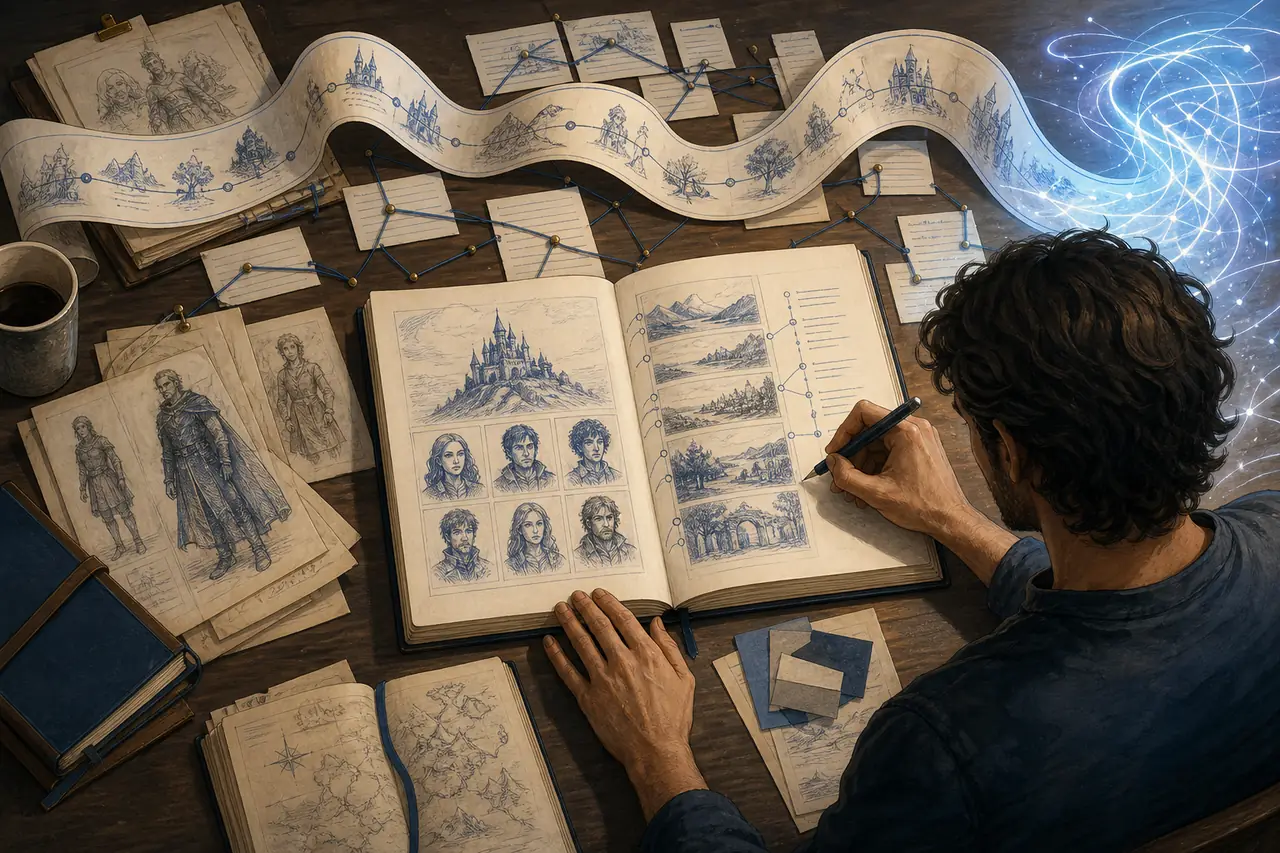
Build a Story Bible Before You Ask for Long Drafts
A story bible is a compact source of truth for the project. It does not need to contain every worldbuilding detail. It needs to contain the facts that can change what a character does or what a reader understands. Keep it short enough to review and precise enough to catch contradictions.
Store confirmed facts separately from possibilities. If an idea is still optional, label it as a candidate instead of letting the AI treat it as canon. When you change a core fact, update the bible first, then decide which earlier chapters need a revision. This prevents a new request from quietly creating two versions of the same story.
| Field | Record | Test before drafting |
|---|---|---|
| Premise and promise | The protagonist's goal, central conflict, genre promise, and ending question. | Does the next chapter increase pressure on the promise? |
| Character decisions | Wants, fears, secrets, relationships, boundaries, and the choices that changed them. | Would this character choose the proposed action for a visible reason? |
| World rules | Limits of technology, magic, institutions, geography, and social consequences. | Does the scene obey a rule already shown to the reader? |
| Timeline | Dates, travel time, age, season, injuries, and the order of discoveries. | Can the characters physically and emotionally reach this moment? |
| Open threads | Promises, clues, objects, questions, and consequences that still need a payoff. | Is this thread advancing, resolving, or being intentionally abandoned? |
Write a Novel Chapter by Chapter
A long story becomes manageable when each chapter has a local objective and a relationship to the larger arc. The local objective answers what the viewpoint character is trying to do now. The larger arc answers why this attempt matters and what it changes. Give the AI both levels, but do not ask it to solve the entire novel every time.
A useful handoff contains the previous chapter's confirmed change, the current chapter's goal, the obstacle, the facts that must appear, the information that must remain hidden, and the ending turn. After the draft, ask for a neutral report of what the chapter actually established. Compare that report with what you intended before accepting the prose.
| Stage | Input | Output | Review |
|---|---|---|---|
| Plan | Chapter job, viewpoint, scene goal, obstacle, and required continuity facts. | A beat list with a clear change at the end. | Cut beats that repeat without adding pressure or information. |
| Draft | The approved brief plus voice and format constraints. | A scene draft or a small set of scene options. | Keep specific choices; rewrite generic language and convenient coincidences. |
| Audit | The draft and the story-bible ledger. | A fact list, open-thread list, and possible contradictions. | Verify the report against the manuscript instead of trusting it automatically. |
| Revise | Your decisions about pace, voice, character logic, and payoff. | A chapter that changes the story and prepares the next choice. | Read without the prompt and judge the chapter as a reader would. |

Check Continuity, Character Logic, and Voice
Continuity is more than catching a wrong eye color. It is the agreement between what the story has shown and what the characters are now willing to do. A protagonist who refused help in chapter three should not accept a dangerous alliance in chapter seven unless the intervening pressure explains the change. A secret should alter behavior before it is revealed, even if the reader does not know the reason yet.
Use separate passes so one concern does not hide another. First check hard facts such as names, dates, objects, geography, injuries, and point of view. Then check motivations, relationship shifts, promises, and the order of revelations. Finally read for voice: word choice, rhythm, image patterns, and what the viewpoint character notices or ignores.
- Make a fact ledger after every chapter and mark uncertain ideas as provisional.
- Ask which earlier scene makes the current choice possible, not only whether the sentence sounds plausible.
- Track unresolved threads by their promised payoff and the last chapter that moved them.
- Compare the opening and climax choices to confirm that the character's change is visible.
- Read a clean chapter without the AI prompt; prompt language should never leak into the manuscript's voice.
A Reusable AI Novel Writer Prompt Template
Give the model a bounded assignment and ask it to surface uncertainty instead of inventing facts. Replace the bracketed parts with your own project details.
Project: [one-sentence premise and genre promise]
Chapter: [number and job in the larger arc]
Viewpoint: [character, tense, and distance]
Scene goal: [what the viewpoint character tries to achieve]
Obstacle: [who or what makes the goal costly]
Confirmed facts: [names, timeline, setting rules, prior changes]
Required turn: [what must be different by the end]
Do not invent: [facts that are unknown or must remain hidden]
Output: [beat list, scene draft, or continuity report]
Before drafting, list any ambiguity that needs a decision.
The last line matters because it makes uncertainty visible. If the response asks a useful question, answer it in the story bible or revise the brief. Do not let a confident guess become an accidental canon fact.
Common AI Novel-Writing Mistakes and Fixes
Most long-form failures come from process, not from a lack of fluent sentences. These are the problems worth checking before you generate more chapters.
| Mistake | Why it weakens the novel | Better fix |
|---|---|---|
| Generating the whole novel in one prompt | The output may be long but cannot reliably preserve every decision, thread, and voice constraint. | Plan the arc, outline chapters, and draft in reviewable units. |
| Treating a character sheet as a character | Adjectives do not prove how a person behaves when the cost rises. | Record goals, fears, contradictions, and decisions under pressure. |
| Letting AI invent canon | A plausible new detail can contradict earlier chapters or weaken a later reveal. | Separate confirmed facts from options and run an audit after each chapter. |
| Using continuity as a final polish | Late fixes can change the motivation for scenes that follow the original error. | Check facts and open threads before drafting the next chapter. |
| Accepting generic prose because it is grammatical | Clean sentences can erase the viewpoint, texture, and moral pressure that make the novel yours. | Rewrite for concrete perception, specific choices, rhythm, and consequence. |
AI Novel Writer FAQ
Further reading
For another perspective on using AI as a sounding board, research assistant, and editorial partner while keeping the writer in control, see OpenAI's Writing with AI examples.
The Reliable Way to Use an AI Novel Writer
A long story becomes easier to manage when AI is used in small, visible passes. Start with a premise that creates pressure, build a story bible, map the chapter jobs, draft from narrow briefs, and record confirmed changes before moving forward.
The goal is not to make the tool sound like an author. The goal is to give yourself more room to test possibilities while protecting the choices, voice, continuity, and meaning that make the novel yours.